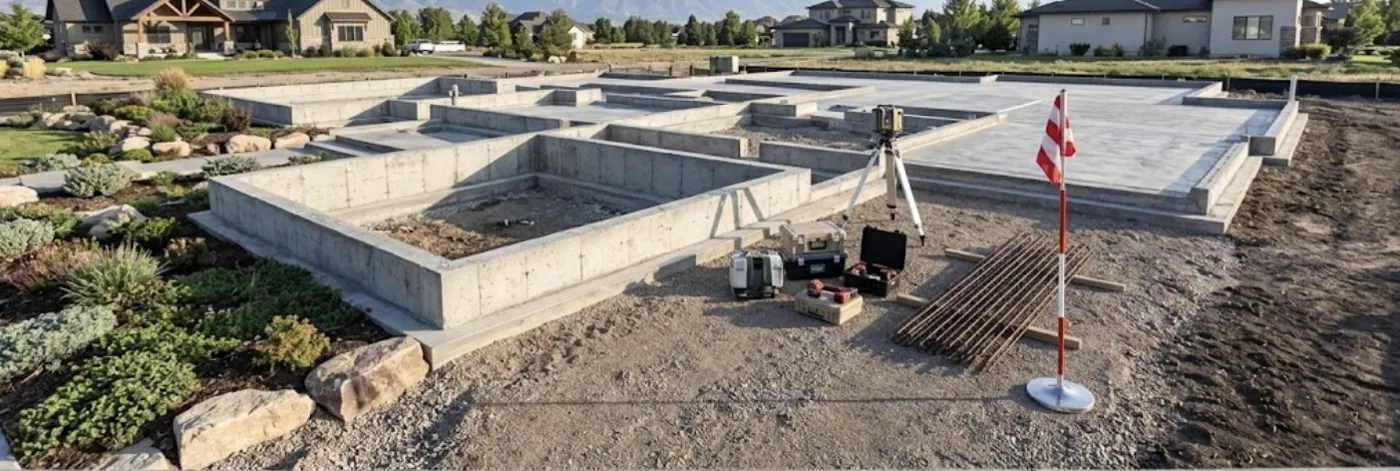
We pour garage and shop slabs, shed pads, footings and foundations for additions and ADUs in San Jose. Expansive clay and earthquake loads drive the design, and building slabs follow the approved plans and city inspection. Tell us what the slab will carry.
A slab or footing in San Jose is designed around two things the building code takes seriously here: expansive clay and earthquakes. Clay that swells and shrinks can lift the edge of a slab or let the middle drop. Ground shaking tests every connection between a structure and its footing. For anything that carries a building, the thickness, the steel and the anchor bolts come from the approved plans and, where the city asks for one, a soils report.
We pour garage and shop slabs, shed and equipment pads, footings for additions and accessory dwelling units, and stem walls. Preparation is where the work is. Topsoil and soft material come out, the subgrade is compacted, rock base and a vapor barrier go down where the slab will be indoors, and reinforcement is tied and supported so it ends up inside the concrete and not lying on the dirt. Building slabs are inspected by the city before the pour.
Frost is not a design issue in this valley, since the ground does not freeze to any depth. Footing depth is set by the code minimum and by the soil. Before you call, it helps to know what will sit on the slab and whether you have plans. A simple shed pad can be quoted from a site visit. A building foundation is quoted from drawings.
Slabs & foundations in San Jose: common questions
Do I need a permit for a slab in San Jose?
A slab that supports a building, an addition, an ADU or a garage is part of a building permit. A small pad on the ground for a shed or bins often is not, depending on the structure. We check with the City of San Jose Permit Center for your address.
Does clay soil mean I need a thicker slab?
Not always thicker, but better supported. On expansive clay the usual answers are a compacted rock base, more steel, deeper edges and keeping water away from the perimeter. For a building, an engineer or soils report decides.
Can you pour a foundation for an ADU?
Yes, to the approved plans. ADU foundations in San Jose are engineered for seismic loads and the soil on the lot, and the city inspects the forms and steel before concrete is placed.
How it works
- Free estimate: Call, text or book online. We visit and measure.
- Written quote: Clear pricing with finish options.
- Prep & forms: We excavate, grade, compact the base and set forms and reinforcement.
- Pour, finish & cure: We pour, finish, cut control joints and tell you when you can use it.