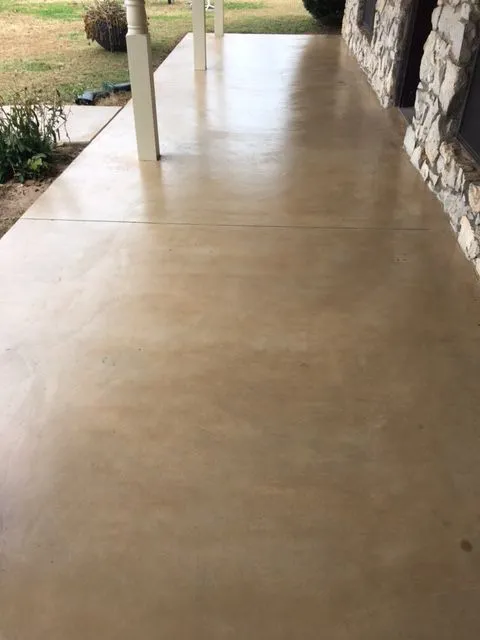
Crack repairs are $100 to $400 and larger repairs are $600 to $3,000 in the national figures. In San Jose the cause is usually under the slab: clay that swells and shrinks, a tree root, or water from a sprinkler or downspout. Fix the cause or the repair will not hold.
The dollar figures on this page are national ranges that HomeGuide published for 2026. They are not quotes from us. Bay Area labor, ready-mix prices, access to your yard and the soil on your lot all move the real number. Last checked October 2026.
How much does concrete repair cost?
National concrete repair cost figures are $100 to $400 to fix cracks in a driveway and $600 to $3,000 for major repairs or resurfacing. Patching is $3 to $8 per square foot. Crack repair is $0.50 to $3 per linear foot.
| Repair | National cost (HomeGuide, 2026) |
|---|---|
| Crack repair | $0.50 to $3 per linear foot |
| Patching | $3 to $8 per sq ft |
| Resurfacing | $3 to $7 per sq ft |
| Leveling | $3 to $12 per sq ft |
| Mudjacking | $4 to $9 per sq ft |
| Foam lifting | $8 to $25 per sq ft |
Can cracked concrete be repaired or does it have to be replaced?
It can be repaired when the slab is still flat and solid on both sides of the crack. Those cracks are cleaned and sealed so water stays out of the clay below. It should be replaced when one side is higher, the pieces rock under foot, or the slab has broken into a web of small pieces. That section has lost its support and no filler changes that.
Why is my concrete driveway cracking?
In San Jose the main reason is the soil. Adobe clay shrinks in the dry months and swells in the wet ones, and a thin slab with no steel cannot ride that movement. Other causes are roots from street and yard trees, too few control joints, sprinklers soaking one edge, and heavy vehicles on a slab built for cars. Small earthquakes add to existing cracks but rarely start them.
Is it cheaper to repair or replace?
It is cheaper to repair today, and sometimes cheaper to replace over ten years. Repairs cost $3 to $8 per square foot for patching against $6 to $15 for a new driveway plus $3 to $8 for removal. If the slab is stable, repair wins. If it is still moving, you pay for the repair and then for the replacement.
Why is my concrete sinking, and can it be leveled?
Concrete sinks when the soil under it shrinks, washes out or was never compacted. Here that often means clay drying out in a drought year, a leaking irrigation line, or loose backfill beside a foundation or pool. A slab that sank in one piece can often be lifted back. A slab that broke as it sank is replaced.
How much does concrete leveling cost, and is mudjacking or foam better?
Concrete leveling cost runs $3 to $12 per square foot nationally, with typical jobs at $700 to $5,000 and a minimum job fee of $300 to $700. Mudjacking is $4 to $9 per square foot and foam is $8 to $25.
Foam is lighter, needs smaller holes and cures within minutes. Mudjacking uses a heavier cement slurry, costs less and fills large voids well. On clay that is already struggling to hold the slab, the lighter material has an advantage. Neither one fixes the reason the slab dropped.
Is foam lifting a permanent fix, or will the slab drop again?
It is a permanent fix only if the cause is gone. The foam does not break down, but the clay under it keeps shrinking and swelling, and a leaking pipe keeps washing soil away. Fix the water first. Then a lift can last for many years. Be wary of anyone who guarantees it forever.
Can concrete be resurfaced instead of replaced?
Yes, when the slab is sound and only the top is worn, stained or lightly pitted. Resurfacing costs $3 to $7 per square foot nationally, $6 to $20 for a decorative or stamped overlay, and $1,200 to $2,900 for a two-car driveway. It cannot hide movement. Cracks in the slab come through the new layer.
My old patio has cracks and some flaking. Can it be resurfaced, and how long will it last?
It can be resurfaced if the cracks are tight and the patio is still level. How long it will last depends on the slab below and the preparation, so nobody honest can give you a set number of years. On a stable slab with the loose surface ground off first, a resurfacing layer gives years of use. On a patio that moves each season, it cracks along the old lines within a winter or two.
Why is my concrete spalling or flaking, and can it be fixed without replacing the slab?
In this climate, spalling or flaking usually comes from a weak surface, not from frost. Water added on top during finishing, a pour that dried too fast in summer heat, or a slab finished while bleed water was still on it all leave a thin, soft top layer. Salts carried up from wet soil can also break the surface over time.
Yes, a flaking surface can be repaired if the damage is shallow and the concrete below is hard. The weak layer is ground away and a bonded resurfacer is applied. If the flaking goes deep or the slab is soft all the way through, replacement is the honest answer.
Why is my driveway lifting or heaving?
There is no frost heave in San Jose. A driveway lifting or heaving here is being pushed by a tree root or by clay swelling after it gets wet, often along the edge nearest a lawn or planter. Roots lift in a hump you can trace back to the tree. Clay lifts a whole edge and may settle again in summer.
Can you pour new concrete over old concrete?
You can, but it is seldom the right call for a driveway. New concrete over old concrete raises the surface, which causes trouble at the garage, the sidewalk and door thresholds, and every crack and joint below shows up above. A thin bonded overlay on a stable slab works. A thick new slab on top of a broken one does not.
Can I patch a wide crack, or will the patch pop out?
A patch in a wide crack holds when the crack has stopped moving and the edges are cut clean and square. A patch smeared into a moving crack pops out, usually within a year. For cracks that open and close with the seasons, a flexible sealant is better than a rigid patch.
How do I fix a sunken walkway that is a trip hazard? Can the raised edge just be ground down?
Lift it, grind it or replace it. A panel that dropped in one piece can be raised. A small lip can be ground down. A broken panel is replaced. On the public sidewalk, San Jose counts a vertical separation of more than half an inch as a defect that the owner must repair, so a trip hazard there should not wait.
Yes, for small differences. Grinding takes an edge down to a gentle slope and is quick. It thins the slab at that point and leaves a rough, lighter-colored strip. For the public sidewalk, ask the Department of Transportation whether grinding is accepted for your defect before paying for it.
To get a real price for your address, book a free on-site estimate. Call (408) 889-7434 or text us a photo and rough measurements.