Some flaws in new concrete are normal and some are workmanship. Here is how to tell them apart in San Jose's dry, warm climate, and what California law gives you when a contractor will not return.
Why is my new concrete already cracking?
New concrete cracks because it shrinks as it dries. In the Santa Clara Valley the dry air, sun and afternoon breeze speed that up. Hairline cracks in the first weeks are common and mostly cosmetic. Cracks that are wide, that have one side higher, or that run where a control joint should have been point to a problem with the base, the joints or the curing.
Is the contractor responsible for a crack that appears weeks later?
The contractor is responsible when the crack comes from poor work, such as missing joints, a thin slab, bad base or no curing. Thin shrinkage cracks are widely treated as normal. Start with your contract and any written warranty. In California you can also bring a workmanship complaint to the Contractors State License Board.
Why does my new concrete have dark and light patches?
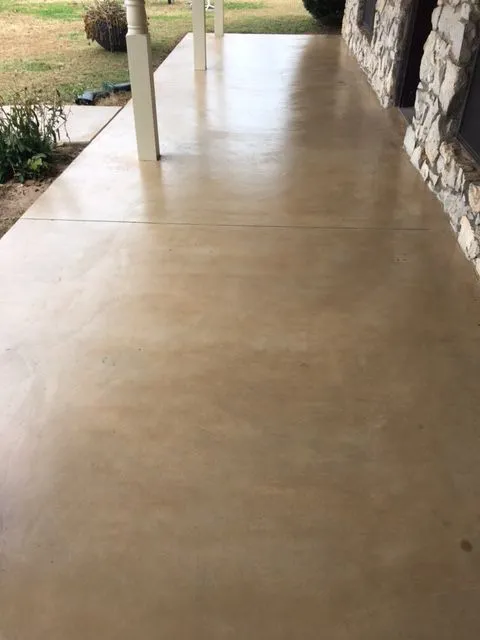
Dark and light patches come from uneven drying, different loads of concrete, extra trowelling in some spots or a curing cover that touched the surface. Shade from a fence or a tree is enough to do it here in summer. Much of the blotchiness fades over the first months. Colored concrete shows it more.
What happens if it rains on fresh concrete?
If it rains on fresh concrete in the first few hours, the surface can be washed, pitted or weakened. After the concrete has set, light rain helps the cure. Rain here comes mostly from November to March and is forecast well, so a pour should be moved or covered. If the surface was damaged, grinding and resurfacing can repair it.
There are footprints, rough spots and a wavy finish with low spots. Is that acceptable?
No. Footprints, trowel marks and low spots that hold water are finishing faults. Photograph them, pour a bucket of water to show where it ponds, and tell the contractor in writing. Small areas can be ground and patched. A surface that holds water against the house should be corrected properly.
Are control joints really necessary, and is it too late to saw-cut them a week later?
Yes. Control joints are planned weak lines that make the slab crack in a straight, hidden place. Without them the cracks wander. On a 4 inch slab they are usually spaced about 8 to 12 feet apart and cut to about a quarter of the depth.
A week is too late. Joints are saw-cut as soon as the slab can take the saw without ravelling, normally within the first day and sooner in hot, dry weather. After a week in a San Jose summer the slab has already picked its own crack lines.
My slab was poured without rebar or mesh and I found out afterward. What now?
First check what the contract said. If steel was in the contract, a slab poured without rebar or mesh is a breach, and you can ask for a remedy in writing. If the contract was silent, a patio on a good base may still perform. A driveway on expansive clay without any reinforcement is more likely to crack apart, so watch it and keep your records.
What can I do if the contractor will not come back to fix it?
Write to the contractor with photos, the defects and a date to respond. If the contractor will not come back, file a complaint with the Contractors State License Board at cslb.ca.gov or on 800-321-CSLB (2752). The CSLB can investigate licensed and unlicensed contractors. Small claims court is another route. Keep the contract, payments and messages together.
My new stamped concrete is slippery, cloudy or peeling. Can that be fixed?
Yes. Slippery stamped concrete is nearly always a sealer problem. A glossy sealer with no grit is slick when wet. The fix is a fresh coat with a non-slip additive, or stripping to a lower-sheen product. Ask for it before the first rainy season.
Fading, clouding and peeling are sealer faults too. Cloudy or white sealer means moisture was trapped under it, often because it was applied too thick or over a damp slab. Peeling means it did not bond. Fading is the sealer wearing in strong sun. The cure is to strip or re-dissolve the old sealer and reapply thinly in dry conditions.
The surface is flaking in the first year, or it was poured in extreme heat and looks bad. Is that a defect?
Usually, yes. San Jose has almost no freezing weather and no road salt, so flaking in the first year points to finishing or curing: water worked into the top, or the surface drying too fast. Raise it with the contractor in writing while it is recent.
It may have been. Concrete poured in heat sets fast, so finishers have less time, and the surface can dry before the body of the slab. That gives fine surface cracks, rough texture and weak spots. Heat waves in the valley reach the high 90s and above. A careful crew pours at dawn, dampens the base and cures the slab at once.
The stamped pattern is crooked and uneven. Should I hold back the final payment?
You can hold back part of the final payment in proportion to a real, documented defect. The CSLB says payments should not get ahead of the work. Put the defect in writing with photos, state what you are withholding and why, and ask for a repair plan. Do not withhold the whole balance for a small flaw.
The crew left ruts in my lawn, concrete washout and splatter. Who fixes that?
The contractor does, unless your contract says otherwise. Ruts, washout piles and splatter on walls or the neighbor's fence are site damage. Washout should never go into the gutter, because street drains in San Jose run to creeks and the bay. Report it promptly and note it before final payment.
My new pad is out of level. Is that a problem?
It depends on the use. Outdoor slabs are meant to slope a little so water runs off. A pad for a shed, a hot tub or equipment should be flat to the tolerance you agreed. If it is out of level against what the contract called for, ask for correction, which may mean grinding, a topping or a repour.
The forms were left on and now they are stuck. Is that harmful?
It is untidy more than harmful. Forms are normally pulled within a day or two. Left for weeks, the boards swell and grip the concrete, and prying them off can chip the edge. Ask the contractor to remove them carefully and backfill along the slab edge.
To get a real price for your address, book a free on-site estimate. Call (408) 889-7434 or text us a photo and rough measurements.